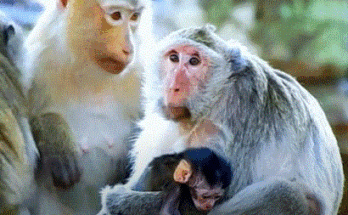
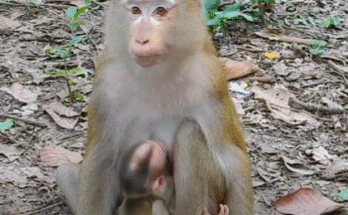
In the dense green shadows of Angkor Wat’s ancient forest, life can be breathtakingly beautiful—and tragically cruel. Among the crumbling stone temples and towering trees, a story unfolded that left every witness shaken to their core. It was not the call of a bird or the hum of cicadas that pierced the silence that day, but the desperate, anguished cry of a mother monkey whose baby had just been thrown to the ground.

The jungle held its breath.
The Innocence of a New Beginning
The newborn was fragile, its tiny hands still unsure of their grip, its body light as a feather. New life in the wild is always precarious, but nothing prepares you for the moment when innocence collides with violence. The baby had nestled close to its mother only moments before, safe in the rhythm of her heartbeat. But danger can come not from predators in the forest, but from within the troop itself.
Susan, an older female known for her unpredictable temper, lashed out in sudden fury. Before anyone could intervene, she grabbed the tiny infant and, with a shocking force, hurled the newborn to the ground.
A Cry That Shook the Forest
The sound of the baby hitting the earth was followed by silence. Then came the scream—the mother’s cry. It was not just a noise; it was grief, rage, and despair woven into one unearthly sound. Anyone who has ever heard it knows: it is a cry that sears itself into your memory forever.
She rushed to her baby, cradling the fragile body, checking desperately for signs of life. Every tremor of her touch carried hope. The newborn whimpered faintly, proving that the forest had not claimed it yet.
The Struggle to Survive
Other monkeys gathered, some curious, some indifferent, while a few looked away as if in shame. This is the brutal reality of primate life: hierarchy, dominance, and aggression are as much a part of survival as food and shelter. But in that moment, all eyes turned to the mother.
Her trembling arms shielded her baby, her lips brushing against its face as if whispering comfort. The newborn struggled to lift its tiny head, a fragile act of defiance against the cruelty it had just endured.
Witnesses stood frozen, torn between sorrow and helplessness. In the ancient setting of Angkor Wat, where history and spirituality breathe from every stone, it was as though the universe itself was watching, asking: how can innocence survive in a world so harsh?
Humanity Reflected in Their Eyes
For those who saw the tragedy unfold, the pain was not distant. It felt human, raw, and personal. Because whether in the jungles of Cambodia or the suburbs of America, the bond between a mother and her child is sacred. When that bond is threatened, it strikes at something universal in all of us.
The mother’s eyes, filled with desperation, mirrored the tears of those who watched. Her cries seemed to echo beyond the trees, reaching into the hearts of anyone who would listen—even thousands of miles away.
Why We Must Bear Witness
This heartbreaking moment is not just a story about monkeys. It is a reminder of the fragile beauty of life, of how quickly joy can turn to pain. It calls us to see our shared humanity with animals, to recognize that their struggles, fears, and loves are not so different from our own.
As the sun dipped lower over the Angkor Wat ruins, the mother still clung to her baby, her determination clear. Against all odds, she would fight for her child. And in that stubborn resilience, we are reminded that love, in its purest form, is the strongest force of all.