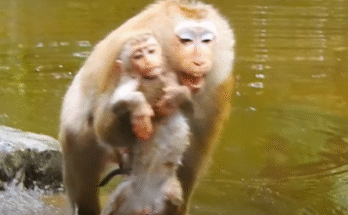
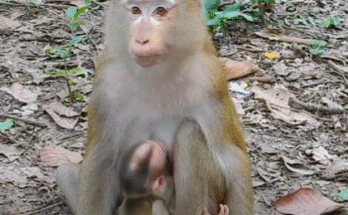
Deep in the heart of Cambodia’s Angkor Wat forest, where ancient stone temples sleep beneath towering silk-cotton trees, lives a tiny soul who has learned to turn loneliness into love. Her name is Baila—a baby monkey once abandoned, now a little ambassador of joy for anyone lucky enough to meet her.
On a warm golden afternoon, the forest was alive with cicadas singing and the distant echo of temple bells. Tourists strolled the worn stone paths, cameras swinging from their shoulders, trying to capture the history that seemed to breathe from every moss-covered wall.
That’s when Baila appeared.
She wasn’t shy—oh no. This tiny macaque, with her curious eyes and tufted baby fur, bounded toward the newcomers like an old friend. And at the center of her attention? A group of children wearing the most colorful little shoes, bright yellow and shaped like baby ducks.
At first, the kids giggled and stepped back. But Baila stopped just short of them, sitting upright, tilting her head as if to say, “Well? Are we going to play?” Her tiny hands reached out toward those duck-shoes, tapping them gently, fascinated by the soft squeaks they made when the children moved.
Baila’s story isn’t one of constant joy. Not long ago, she wandered these same paths alone, her tiny cries swallowed by the dense forest. Her mother was gone—no one knows how or why—and in the wild, that can mean the end for a baby monkey. But Baila, against the odds, survived. And somehow, she decided that humans weren’t a threat—they could be family.
Watching her now, it was clear she had found her own way to heal: through connection.
The children, sensing her harmless playfulness, began to stomp their duck-shoes gently, the squeaks echoing through the trees. Baila’s entire body seemed to light up. She bounced on her hind legs, clapping her little hands together, chasing the shoes in tiny circles. Tourists gathered, phones held high, but the magic wasn’t in the recording—it was in the shared laughter between the children and the orphaned monkey.
One of the kids bent down and extended a hand. Baila reached out carefully, her tiny fingers curling around his. It was a handshake, a silent agreement: You’re my friend now.
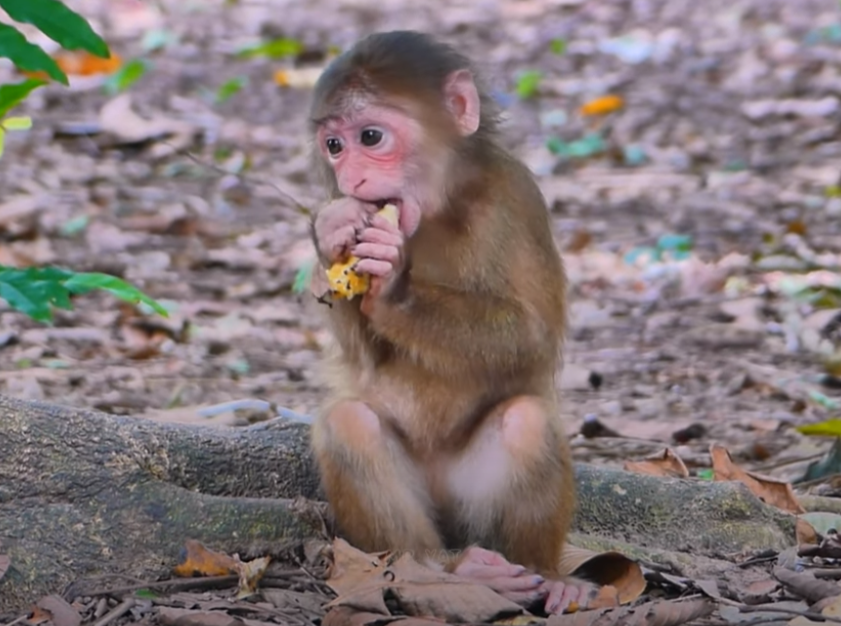
Baila’s playful chase didn’t last long—young macaques tire quickly—but it was long enough to touch everyone who saw it. The forest, ancient and timeless, seemed to stand still around them. In that moment, there was no “tourist” and no “wild animal.” There were only friends.
A grandmother in the group wiped her eyes, smiling as she whispered, “She just needed someone to notice her.” That simple truth seemed to hang in the air.
When the children had to leave, they turned back to wave. Baila stood in the same spot, eyes wide and ears perked, as if memorizing the moment. Then she climbed up a low tree branch, her tiny tail swaying, watching them go.
Later, as the sun dipped low and the forest shifted to its nighttime chorus, I spotted Baila again. She was perched quietly, nibbling on a piece of fruit offered by another visitor. She looked content—not just because she had eaten, but because, for another day, she had been part of a family.
Baila’s story is a reminder of something we often forget: the smallest acts of kindness—a smile, a moment of play, a gentle hand—can change the course of someone’s day… or their life. In the vast, sacred grounds of Angkor Wat, where centuries of history watch from the shadows, one abandoned monkey has written her own chapter, not in stone, but in the hearts of those who meet her.
And if you’re ever lucky enough to wander these paths, keep an eye out. You might just hear the squeak of a pair of baby duck shoes… and see a little face, full of hope, running to greet you.
If you’ve ever doubted that joy can be found in the simplest of moments, think of Baila—the monkey who turned an abandoned life into a series of welcomes, games, and friendships. She reminds us that love doesn’t always come from where you expect it… sometimes, it’s waiting for you in the shape of a tiny, curious monkey, in the middle of an ancient forest, reaching for your hand.