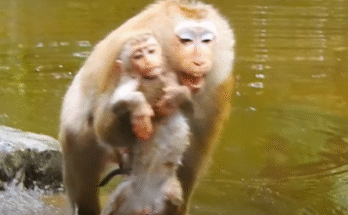
The first light of morning slid gently over Angkor Wat, painting the stone towers in shades of gold and rose. The air was thick with the scent of damp earth and frangipani blossoms, the forest alive with bird calls echoing through the ancient ruins. I had risen early, eager to watch the monkey troops begin their day. I expected noise, play, the usual scuffles and leaps through the banyan roots. What I didn’t expect was the moment that would stop me in my tracks and live in my memory forever.
It was there, in the half-light, that I saw him — Big Boss, the undisputed leader of his troop. His broad shoulders caught the glow of dawn, his every movement commanding respect. I had seen him many times before: enforcing order with a single glare, chasing away rivals, keeping his family in line. But this morning, the forest had a surprise for him.
Two baby monkeys, barely steady on their little legs, tumbled forward through the grass. Their squeaks were sharp and excited, their tiny hands clutching vines and roots as they stumbled right into Big Boss’s shadow. For a heartbeat, everything froze.
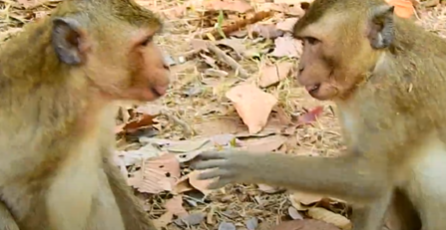
I held my breath, expecting a roar or at least a swipe to shoo them away. Big Boss was a figure of dominance; nothing dared approach him uninvited. Yet what happened next was something no one could have predicted.
The massive male lowered his head ever so slightly, his eyes softening as though he, too, was surprised by the courage — or innocence — of these little ones. One of the babies clambered up his arm, tugging at the thick fur as if it were nothing more than a branch in the forest. The other nestled against his broad chest, squeaking in triumph.
Big Boss didn’t resist. He didn’t push them away. Instead, he allowed it. His great hands — hands capable of striking down rivals — shifted carefully, almost protectively, around the tiny pair.
In that moment, the Angkor forest fell silent. The cicadas paused. Even the wind seemed to wait. And there, in the heart of an ancient temple built by kings, I watched a different kind of majesty: power giving way to tenderness.
I thought of fathers back home in the U.S. — big men with calloused hands, who might not always know how to show affection, yet melt when a toddler climbs into their lap. Watching Big Boss, I realized that parenthood, protection, and love aren’t bound by species. They are written into something far older, something shared across life itself.
The babies squealed and played, tugging at his fur, climbing from his knee to his shoulder, then tumbling down again. And Big Boss? He let them. At times he closed his eyes, almost as if savoring their presence. At others he huffed softly, the sound carrying less warning than warmth.
Around us, the forest carried on — monks chanting in the distance, tourists beginning to stir, birds taking flight across the lotus ponds. Yet within that circle of temple shadow, it was as though time belonged only to them.
It struck me then how Angkor Wat itself is a story of endurance. Stones that once echoed with the footsteps of kings now cradle roots, vines, and wild lives like Big Boss and his troop. The temple is a sanctuary not just for history, but for the timeless lessons nature has to offer.
I couldn’t help but think of my own childhood, climbing onto my grandfather’s lap, feeling safe in the strength of someone so much larger than me. That memory resurfaced so vividly as I watched those babies cling to Big Boss. We humans are not so different. Our children need the same reassurance. Our hearts, too, soften when innocence meets strength.
As the sun rose higher, the babies eventually darted off, distracted by a fluttering butterfly. Big Boss remained where he was, eyes following them with an expression I swear was half amusement, half pride. He hadn’t expected them. He hadn’t asked for them. Yet for those few minutes, he had let them into his world.
And me? I walked away changed. Because in that silent forest morning, I had witnessed something that spoke louder than any sermon or scripture: that even the strongest among us are not weakened by gentleness. They are made greater by it.