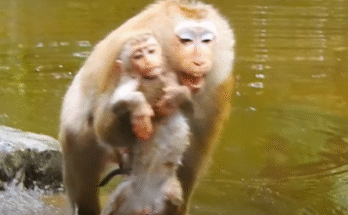
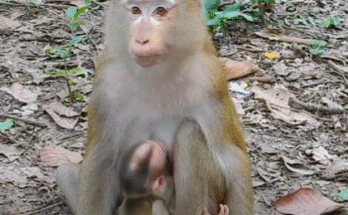
There are certain moments in the Angkor Wat forest that never leave you. This one, with little Tinky’s anguished cries echoing beneath the ancient stone canopy, is something I can still hear in my heart. What should have been a day of quiet joy turned into a memory of heartbreak and raw emotion—etched forever into the ruins of time.
The afternoon light filtered through the towering banyan roots, golden and soft. Birds chirped in the distance, cicadas hummed their endless song, and for a while, it felt as if the entire forest had taken a breath in unison. I remember smiling, watching the villagers gather near the crumbling walls of an ancient shrine, where a simple ceremony was taking place. The air was rich with the scent of incense, a touch of jasmine, and the earthy dampness of moss-covered stone.
And then, the sound came.
A cry—sharp, ragged, and filled with pain.
It was Tinky. The small monkey’s voice cut through the ceremony like a dagger. His sobs didn’t sound like any ordinary call of the wild; they sounded human, almost like a child crying out after being hurt or betrayed. The villagers turned, their faces etched with confusion and sorrow. I felt my chest tighten, my breath catch, because in that moment, Tinky’s grief wasn’t just his own—it belonged to all of us who heard it.
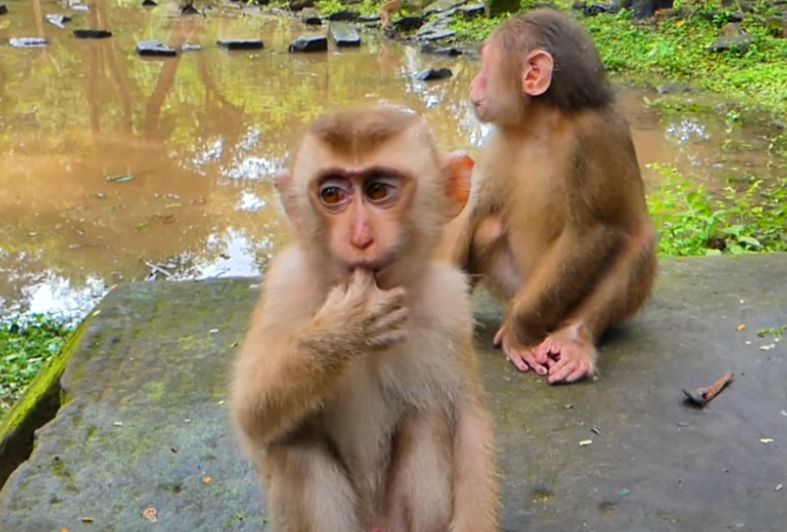
The Moment Baila Appeared
As Tinky wept, clutching himself with tiny trembling arms, another figure leapt from the shadows of the banyan roots. It was Baila—the mischievous monkey known for his bold antics around the Angkor ruins. But that day, Baila’s playfulness had crossed into something startling.
In a blur of motion, he bounded toward the groom, his dark eyes blazing with wild energy. Before anyone could stop him, he reached out, tugging at the man’s ceremonial garb—pulling, tearing, as though to rip open the dignity of the moment itself. The suddenness of it all made hearts stop. Gasps filled the air, the villagers frozen in disbelief.
And over it all, Tinky’s cries grew louder, angrier, more desperate. It was as though Baila’s wild act gave form to the grief Tinky carried, a grief none of us could fully understand but all of us could feel.
The Cry of the Forest
I’ll never forget standing there, helpless. The sound of Tinky’s sobs echoed against the temple stones, bouncing back like the cries of countless generations who had passed before. It was surreal—watching one small monkey’s anguish transform an ancient place into a stage of raw humanity.
The groom stood still, stunned, his garment torn at the edges. He didn’t lash out. He didn’t move. He simply looked down, eyes wide, as though realizing that something greater than a simple ceremony was unfolding before him.
And the forest—oh, the forest seemed to breathe with us. The wind picked up, rustling the leaves like a whispered prayer. The old stones, scarred yet strong, seemed to lean closer, as if listening to Tinky’s every cry. In that moment, Angkor was not just ruins. It was a living witness to sorrow, love, and the unpredictable nature of life.
Reflection and Helplessness
I wanted to reach out, to comfort Tinky, to hush his tears. But sometimes, the forest teaches us that not all pain can be silenced, and not all hearts can be mended in a single moment. Tinky’s sobs were not just sounds—they were the embodiment of grief itself, something that must be felt, endured, and carried.
Baila, realizing the chaos he had caused, retreated into the shadows. His figure melted into the trees, leaving behind only the memory of his bold intrusion. For a brief moment, his act had exposed the fragile line between joy and heartbreak, between ritual and reality.
The Aftermath
Slowly, villagers gathered around Tinky. A gentle hand reached down, offering food and comfort. The groom straightened his torn garment, but his eyes lingered on the trembling monkey. His expression wasn’t anger—it was something softer, a mix of sorrow and understanding.
Life in the forest has always been unpredictable. Animals and humans share space, share moments, and sometimes, as we witnessed that day, share emotions too raw to ignore. Tinky’s pain became our pain. His sobs became the soundtrack of an afternoon none of us will forget.
As the sun began to dip, painting the ruins in shades of gold and crimson, the forest finally grew quiet again. The cries faded, but their echo remained in our hearts.
That evening, as I walked away from the shrine, I looked back one last time. The banyan roots seemed to stretch further over the temple walls, as if cradling the stones in a timeless embrace. And I realized: sometimes, the forest doesn’t just witness our lives—it weeps with us, mourns with us, and teaches us that even in sorrow, we are never alone.